
From TV to Interactive Experience: Designing The Voice Yellow Room
Adopted into the global The Voice format and implemented across multiple countries, transforming passive viewers into active participants.
Project for: Talpa Network / Acunmedya
My Role: I originated and developed the Yellow Room concept as part of the brain team, identifying the opportunity to transform passive viewers into active participants within The Voice format.
I defined the core interaction model, user experience, and scalable structure of the concept, ensuring it could work across different markets, sponsors, and production setups.
The concept was later adopted by Talpa Network and integrated into the official format, reaching global audiences.
This concept directly contributed to new revenue streams through sponsorship integrations and increased audience engagement.
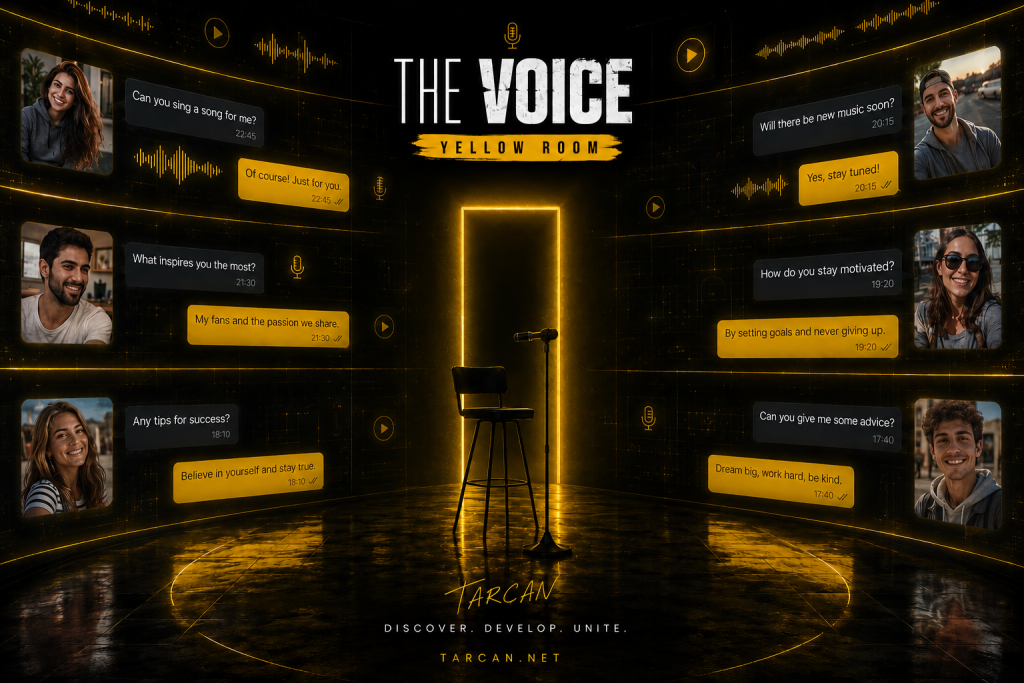
The Idea Behind the Yellow Room
The Yellow Room started from a simple but powerful observation: millions of people were watching The Voice, but their role was mostly passive.
They could vote, follow the show, and support contestants, but they didn’t have a real way to feel personally connected to them.
I created the Yellow Room concept to close that gap.
The idea was to build a digital interaction space where viewers could send messages, ask questions, follow exclusive content, and feel closer to the contestants outside the main broadcast.
It turned The Voice from a one-way TV format into a more personal, interactive experience.
Challenges
Designing for a live TV format required balancing simplicity for viewers, flexibility for production teams, and consistency across different countries and sponsors.
The experience had to be easy to understand instantly, while still being scalable and adaptable for global use.

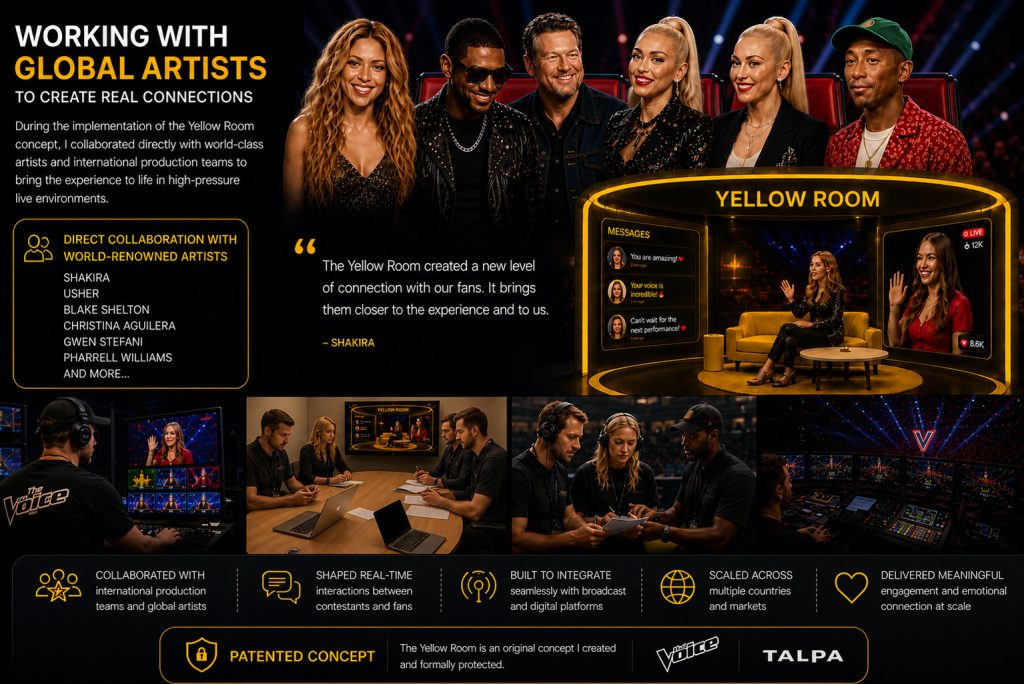
Working with Global Artists & Production Teams
As part of the implementation phase, I collaborated closely with international production teams and worked directly with globally recognized artists such as Shakira, Usher, Blake Shelton, Christina Aguilera, Gwen Stefani, Pharrell Williams, etc., in high-pressure live production environments, ensuring the experience could be delivered smoothly within real-time broadcast constraints.
The room’s visual identity was designed to be sponsor-adaptable. Depending on the market and brand partnership, the same concept could appear as the Yellow Room, Red Room, or another branded version while keeping the core interaction model intact.
The Yellow Room concept is an original idea developed by me and formally protected, forming the foundation of its implementation across The Voice format.
From Broadcast Format to Scalable Digital Experience
The Yellow Room was not designed as a one-time campaign. It was created as a flexible format extension.
The same core idea could work across different countries, production teams, sponsors, celebrity coaches, contestants, and audience behaviors.
The room could also change visually based on the sponsor’s brand identity. In Turkey, the concept first appeared as the Red Room because Vodafone was the sponsor. In other markets, the color and branding could adapt while the interaction model stayed the same.
This flexibility made the concept commercially valuable and helped create a new sponsorship model around The Voice.
The Concept in Different Markets
The videos below show how the Yellow Room concept was adapted across different countries and production setups.
Although the visual identity changed from market to market, the core experience stayed the same: giving viewers a direct emotional and digital connection with the people they watched on TV.
The Voice America
Each implementation below shows how the same core idea scaled across different markets, production teams, and audiences.
This example shows how the Yellow Room concept scaled into one of the biggest versions of The Voice format.
For the American production, the experience had to work around a much larger entertainment ecosystem, including globally known artists, high audience expectations, and a more complex production environment.
In this version, the Yellow Room becomes more than a backstage feature. It works as an extension of the show’s emotional world.
The value of the concept is that it creates another layer around the main broadcast. Viewers don’t just watch contestants perform. They get access to a more personal space where contestants, coaches, and the production can create extra moments outside the stage.
During the rollout, I worked directly with international production teams and globally recognized artists, including Shakira, Usher, Blake Shelton, Christina Aguilera, Gwen Stefani, and Pharrell Williams.
This was important because the concept had to be simple enough for viewers, flexible enough for production teams, and strong enough to fit inside a global entertainment format.
The Voice Turkey (Sarı Oda)
This was one of the key implementations of the concept and a strong example of how the Yellow Room could connect audience engagement, sponsorship, and entertainment content in one experience.
In Turkey, the concept became a direct bridge between viewers and contestants.
The room gave viewers a sense of access. They could send messages, ask questions, and feel closer to the people they were watching on TV.
This was especially important for a show like The Voice, where emotional connection is one of the biggest drivers of engagement. The audience doesn’t only follow performances. They follow personalities, stories, reactions, and relationships.
The room created a dedicated space for that emotional layer.
It also proved the sponsorship potential of the idea. Since the room’s visual identity could change based on the sponsor, it became more than a digital feature. It became a branded experience that could generate commercial value while still feeling connected to the show.
The Voice Poland (Red Room)
This version shows how the same interaction model could be localized for another market while keeping the structure of the original concept intact.
The Polish version is important because it shows the scalability of the idea.
The core concept didn’t depend on one country, one sponsor, or one production style. It could be adapted to a different audience, a different visual identity, and a different local version of The Voice.
This is what made the Yellow Room powerful as a format extension.
It was not just a digital add-on. It was a reusable experience model that could travel with the format.
For a global TV format, that matters. Every country has different sponsors, different audience habits, and different production needs. The Yellow Room was flexible enough to support all of that without losing its main purpose: bringing viewers closer to the contestants.
The Voice South Africa (Red Room)
This example shows how the concept continued to work across different markets, proving that the interaction model was not limited to one region or one audience type.
The South African version demonstrates the global strength of the concept.
The room gives the format an additional digital layer that can support audience participation, exclusive content, sponsor visibility, and emotional connection.
What makes this valuable is the balance between entertainment and product thinking.
The audience gets a more personal experience. The production team gets more content opportunities. The sponsor gets a branded space. The format owner gets a scalable idea that can be reused across markets.
That combination is what turned the Yellow Room into a format-level innovation rather than just a campaign idea.
Outcome
The Yellow Room became a scalable extension of The Voice format and was adapted across multiple countries.
The concept created a new way for viewers to participate in the show, while also opening a valuable sponsorship model for broadcasters, production companies, and brand partners.
For me, this project is one of the clearest examples of how a simple product idea can create impact at a global entertainment scale.
It connected audience needs, production needs, sponsor value, and format scalability in one concept.
It turned a traditional broadcast format into a hybrid product experience combining media, interaction, and monetization.